
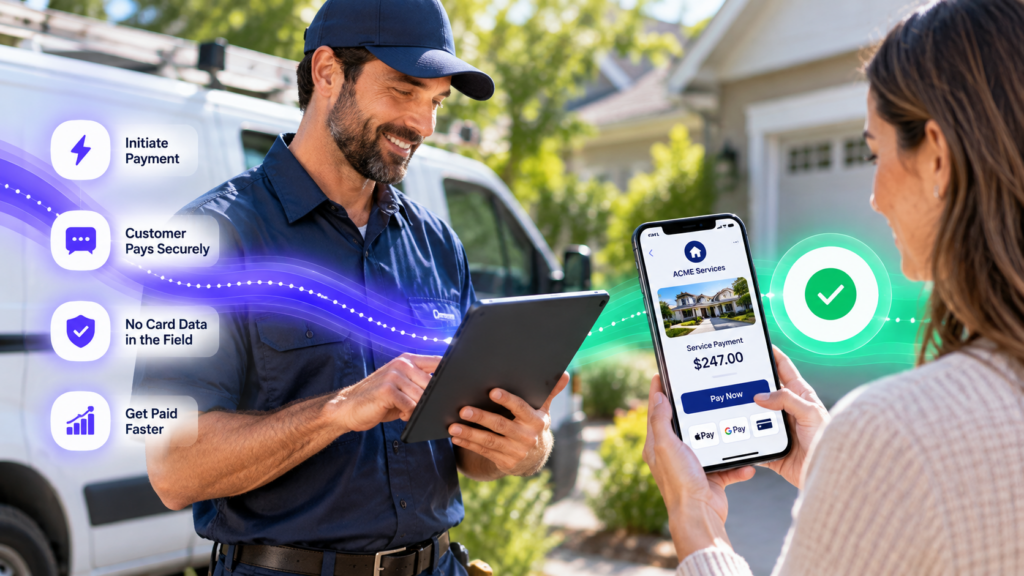
How home service businesses can simplify field payments, reduce payment-data exposure, and let technicians focus on the customer.

For home service businesses, getting paid is part of completing the job.
That doesn’t mean the technician should have to become a payment expert.
Today, field technicians and sales representatives may be expected to do much more than diagnose a problem, explain the work, or complete a service. They may also need to collect a card, enter payment information, manage a card reader, troubleshoot a failed transaction, or tell a customer how to pay later.
For home improvement businesses, the process can be even more complicated. A field sales representative may collect a deposit when the customer agrees to the work, while the remaining balance is due when the project is complete.
Payment is an important part of both experiences. But handling sensitive payment information, managing payment hardware, and navigating payment complexity doesn’t need to be.
Modern payment technology gives home service businesses a different option: let field teams initiate the payment experience while keeping sensitive payment data in the hands of the payer.
Getting Paid Quickly Matters
The best time to collect payment is often when the value of the service is still fresh in the customer’s mind.
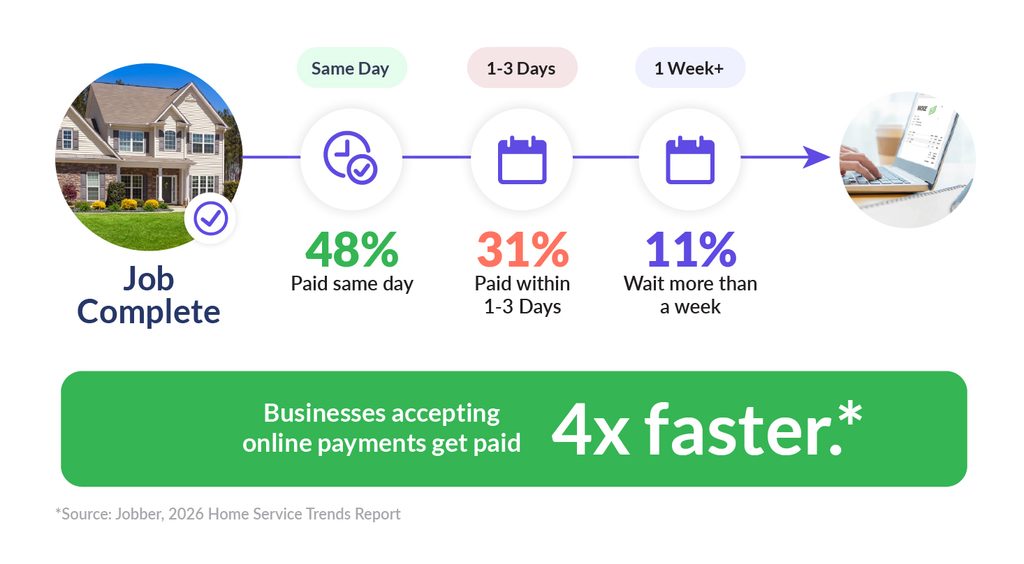
Industry data reinforces the importance of making payment easy at or near job completion. Jobber’s 2026 Home Service Trends Report found that nearly 80% of home service professionals are paid within three days of completing a job. Forty-eight percent report being paid the same day, while 31% receive payment within one to three days.¹
But delays still happen. Jobber found that 11% of businesses wait more than a week to get paid, with longer delays more common for larger jobs or commercial customers. Its platform benchmarks also show that home service businesses accepting online payments get paid four times faster than those that don’t.¹
For home service companies, the opportunity isn’t simply to send invoices faster. It’s to remove the friction between work completed and payment received.
That’s particularly important when technicians and sales representatives are already standing in front of the customer.
The Payment Process Can Put Sensitive Data in the Wrong Hands
Consider a common field payment experience.
A technician finishes a repair and asks for a card. The customer hands it over, and the technician enters the card information into a device.
Or the technician doesn’t have a working card reader, so the customer provides the number another way. In less controlled processes, payment information may even be written down for someone at the office to process later.
What seems like a simple transaction can introduce unnecessary exposure to cardholder data.
The PCI Security Standards Council makes clear that PCI DSS requirements apply when a Primary Account Number (PAN) is stored, processed, or transmitted on any media—including paper records.²
The goal, therefore, shouldn’t be to make every field employee better at handling sensitive payment information.
It should be to reduce the need for them to handle it in the first place.
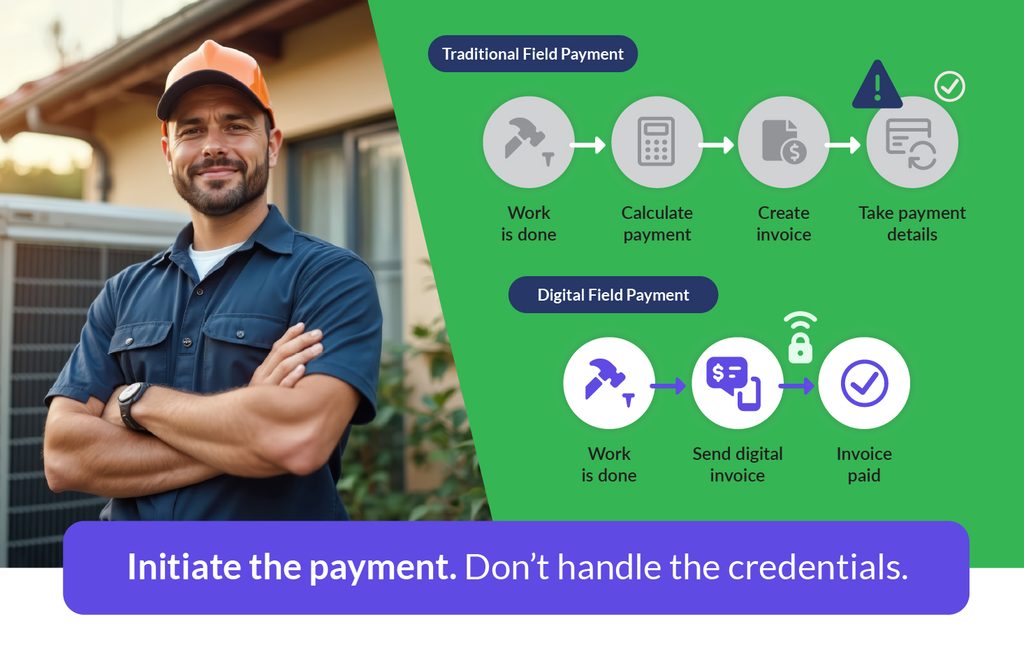
With a digital payment experience, a technician can initiate the payment without needing to see or manually handle the customer’s card information. The customer enters their own payment information through a secure digital experience instead.
The technician helps the business get paid without becoming part of the sensitive payment-data workflow.
Payment Hardware Creates Another Operational Burden
For businesses with a handful of technicians, maintaining payment terminals may not sound like a major undertaking.
At scale, the picture changes.
Put a physical card reader in the hands of every field technician or sales representative and the business now has another distributed hardware fleet to manage.
Devices need to be purchased, provisioned, and assigned. Someone needs to know who has each device. Lost or damaged readers need to be replaced. Connectivity and technical issues need to be resolved. New employees need devices, while departing employees need to return them.
The cost isn’t only the hardware itself. It’s also the operational effort required to keep that hardware working across a distributed workforce.
And field organizations already have plenty competing for their attention.
Deloitte Digital’s 2026 research on field service organizations found that leaders are dealing with rising cost-to-serve, operational inefficiency, skilled-worker shortages, and increasing customer expectations. Deloitte also found that improving technician productivity was the top reported benefit among organizations using field service management technology.³
That raises a simple question:
Does accepting a payment really need another piece of dedicated hardware?
Increasingly, it doesn’t.
The Technician Should Initiate the Payment—Not Manage It
A better field payment experience separates two things that have traditionally been combined:
Initiating a payment and handling the payment credentials.
The field employee should be able to trigger the transaction at the right moment.
The customer should be able to securely complete it.
For a typical home service call, that experience could look like:
Service completed → Payment request initiated → Customer pays from their device → Payment confirmed
For a larger home improvement project, the journey may include multiple payment moments:
Consultation → Agreement → Deposit request → Work scheduled → Project completed → Final payment request
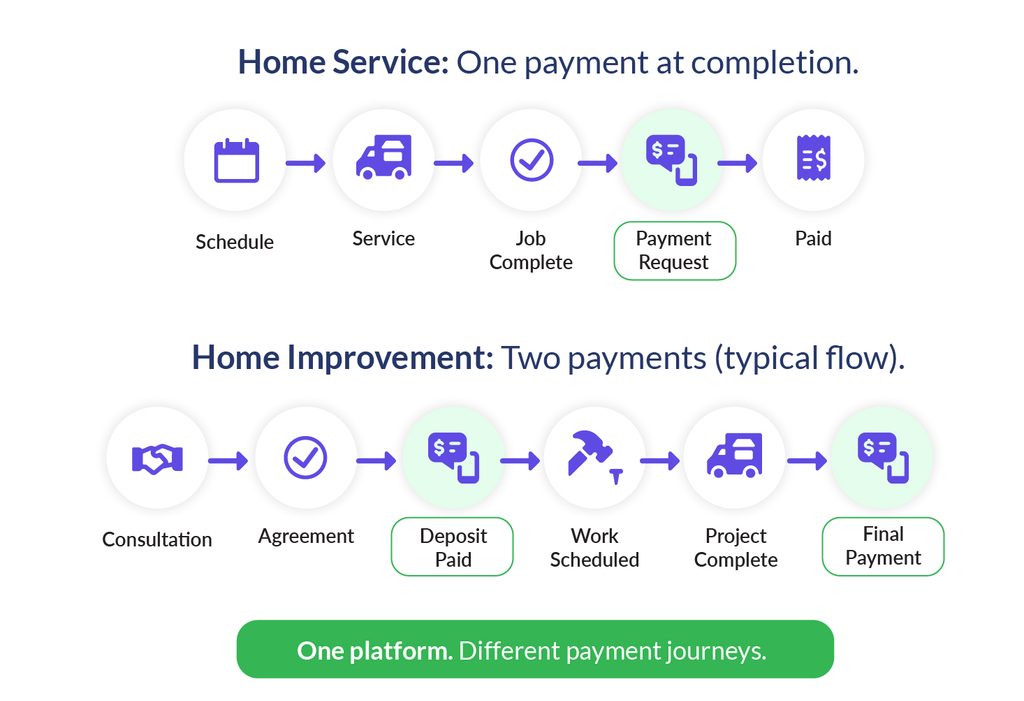
The exact journey will vary by business. Some home improvement companies collect a deposit and final balance. Others may collect the full amount when the customer accepts the proposal or collect a single payment when the work is complete.
Technology shouldn’t force every business into the same payment process. It should support the payment journey that fits the business and the customer.
A Better Experience for Field Teams—and Customers
Authvia enables field service organizations to send secure, mobile-friendly payment requests through digital channels such as SMS and RCS.⁴
Instead of taking the customer’s card or writing down payment information, a technician can initiate a payment request from a phone, tablet, dispatch system, or other connected workflow. The customer then enters their own payment information through the digital payment experience. Authvia supports card, ACH, and digital wallet payments, with payment data encrypted and tokenized.⁴
That changes the technician’s role.
They don’t need to become the payment expert.
They simply initiate the experience.
For the business, that can help:
- Reduce employee interaction with sensitive payment data
- Reduce reliance on dedicated payment hardware in the field
- Create more consistent payment processes across field teams
- Accelerate payment collection
- Reduce administrative follow-up
- Deliver a more convenient customer experience
Authvia’s Point-of-Service Text-to-Pay solution is designed specifically for this type of workflow, allowing technicians or drivers to trigger a payment request while the customer completes payment digitally.⁴
Payment Doesn’t Start or End at Job Completion
Home services and home improvement businesses don’t have just one payment moment.
They may need to collect money throughout the customer journey.
Before the job, that could mean collecting a deposit, capturing a payment method for future use, or securing payment when a customer agrees to the work.
At completion, it could mean collecting the full service amount, a final project balance, or payment for additional work.
After the job, it could mean following up on an outstanding invoice, recovering a past-due balance, or managing recurring maintenance plans.
A digital payment experience can connect these moments rather than treating each one as a separate process.
That builds on a broader opportunity for home service businesses: reducing the time and operational effort between completing a job and turning that work into collected revenue. Authvia explores that challenge further in “The Hidden Cost of Waiting to Get Paid.⁵
Let Technicians Focus on the Service
Field service organizations hire technicians because they’re good at solving customer problems.
They shouldn’t also have to become experts in cardholder data, payment terminals, transaction processing, and payment security.
The better model is simpler:
Give the technician the ability to initiate the payment. Give the customer control over how they complete it. Let the technology handle the complexity in between.

For home service businesses, that can mean fewer manual processes, less payment friction, reduced exposure to sensitive payment data, and a smoother transition from job complete to payment complete.
And for technicians?
They can get back to what they’re there to do: serve the customer.
Explore how Authvia helps field service organizations modernize point-of-service payments and get paid before leaving the job site.⁴
Sources
- Jobber. “2026 Home Service Trends Report.” Jobber, 2026. 2026 Home Service Trends Report.
- PCI Security Standards Council. “Does PCI DSS Apply to Paper With Cardholder Data?” PCI SSC FAQ 1069. PCI Security Standards Council.
- Deloitte Digital. “The Future of Field Service: Technological Maturity Pays Off for Field Service Organizations.” Deloitte Digital, January 2026. The Future of Field Service.
- Authvia. “Point-of-Service Text-to-Pay.” Authvia. Point-of-Service Text-to-Pay for Field Services and Deliveries.
- Authvia. “The Hidden Cost of Waiting to Get Paid.” Authvia. The Hidden Cost of Waiting to Get Paid.
Additional Reading
Authvia, “The Field Services Payment Problem”
https://www.authvia.com/blog/the-field-services-payment-problem/
Authvia Use Case Library
Includes deposit requests, partial payments, payment plans, point-of-service payments and tokenized payment method capture.
https://www.authvia.com/use-cases-all/
PCI Security Standards Council, PCI DSS
https://www.pcisecuritystandards.org/standards/pci-dss/