

From digital payments to agentic commerce, the distance between customer intent and transaction execution is shrinking.
Written by: Chris Brunner, Founder and CEO, Authvia
Originally published by the Mobile Ecosystem Forum (MEF) as a guest article by Authvia Founder and CEO Chris Brunner. Read the original article on MEF
For years, businesses have treated payment as the final step in the customer journey. The work happened upstream: attract the customer, deliver the service, send the bill, then provide a way to pay.

That model is changing.
Consumers are navigating more digital interactions, more payment requests and, in many cases, real financial pressure. The Federal Reserve found that 16% of U.S. adults did not pay all of their bills in full in the prior month.¹
Businesses may not be able to change a customer’s available funds or make their bill more important than another obligation. But they can influence what happens when that customer is ready to act.
Increasingly, the payment experience itself is becoming part of the competition.
Payment Friction Is a Conversion Problem
A customer who doesn’t complete a payment isn’t necessarily a customer who didn’t intend to pay. Sometimes, the process simply gets in the way.
Recent PYMNTS Intelligence research estimates that 62 million U.S. adults have delayed payments because of dissatisfaction with the billing experience, putting roughly $28 billion in monthly bills at risk of delay. The research also found that more than half of Gen Z consumers consider the payment process frustrating or time-consuming.²
For businesses, that makes payment friction more than a customer experience metric. It is a conversion metric.
Every redirect, login, channel switch, repeated authentication or request to re-enter payment information creates another opportunity for intent to become delay.
Different Channels Perform Different Jobs
Reducing friction doesn’t mean choosing one “best” payment channel. Consumers increasingly expect digital options that help them manage and act on their financial obligations.

Fiserv research found that nearly four in five consumers receive bill alerts or reminders, and 67% of those consumers say they appreciate them.³
But the opportunity isn’t simply to send more reminders. It’s to make those interactions actionable.
Email may be valuable for documentation. SMS can create immediacy. RCS and other messaging experiences can combine communication with richer, verified interactions. Voice can support more complex customer needs. Web and mobile experiences remain important.
The opportunity is to orchestrate those channels around the customer, the context and the action they’re trying to take.
Omnichannel isn’t about being everywhere. It’s about making every channel part of the same journey.
Trust Has to Be Designed Into the Experience
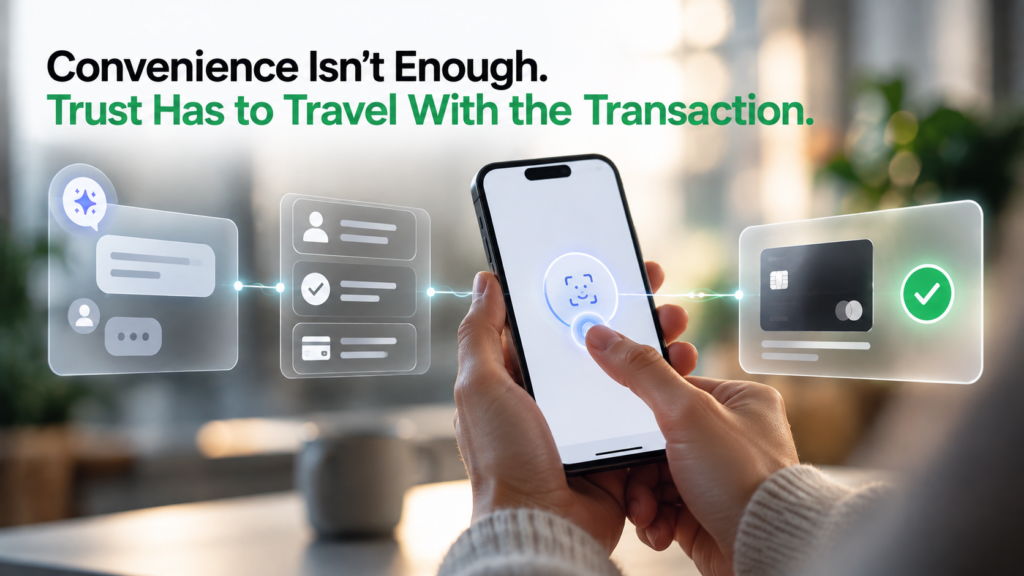
Making a transaction easier to complete doesn’t matter if the customer doesn’t trust the interaction.
That becomes even more important as commerce moves into new digital and AI-powered experiences. Visa’s 2026 Trust Index found that only 23% of U.S. consumers trust generative AI to handle payment transactions on their behalf. When Visa was identified as the brand handling the agentic transaction, that figure rose to 61%.⁴
The numbers illustrate an important point: convenience alone isn’t enough. Consumers also need confidence in who or what is acting and how the transaction will be handled.
That changes the role of identity, authentication and consent. They aren’t simply controls operating behind the scenes. Increasingly, they are visible parts of the customer experience.
The goal isn’t frictionless commerce at the expense of trust. It’s trusted commerce with less unnecessary friction.
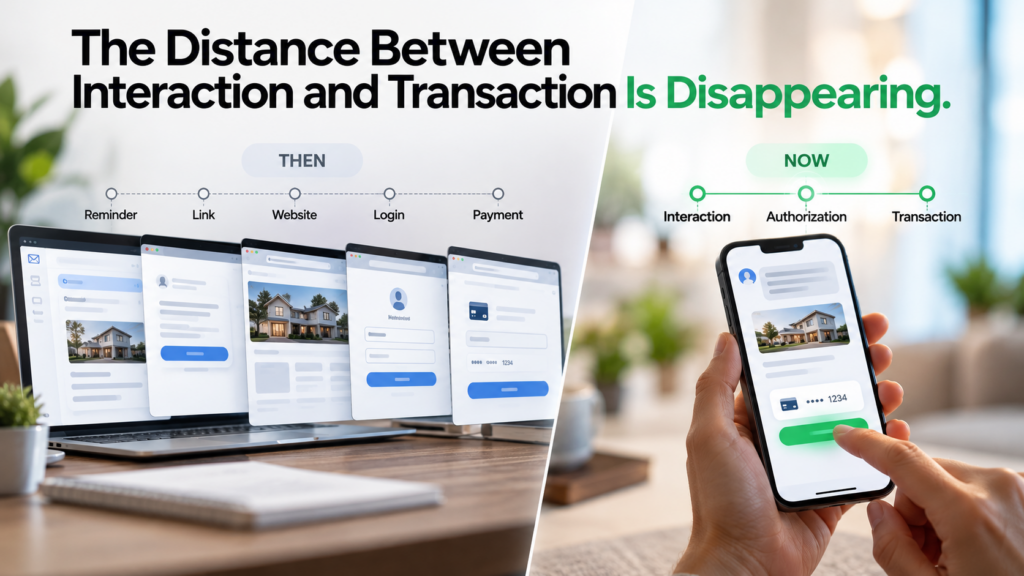
Historically, a payment journey might look something like this:
Reminder → Link → Website → Login → Payment
Increasingly, it can look more like:
Interaction → Authorization → Transaction
The significance goes beyond any single channel.
A customer can express intent through SMS, RCS, email, voice and call center interactions, chat, an app, a web experience or an AI-powered interaction. Once that intent is clear, forcing the customer to abandon the interaction and begin an entirely different transaction journey introduces friction at exactly the wrong moment.
This is why customer engagement is becoming the new point of commerce.
The interaction isn’t simply a way to direct someone toward a transaction. Increasingly, it can become the place where the transaction happens.
AI Makes Authorization Even More Important
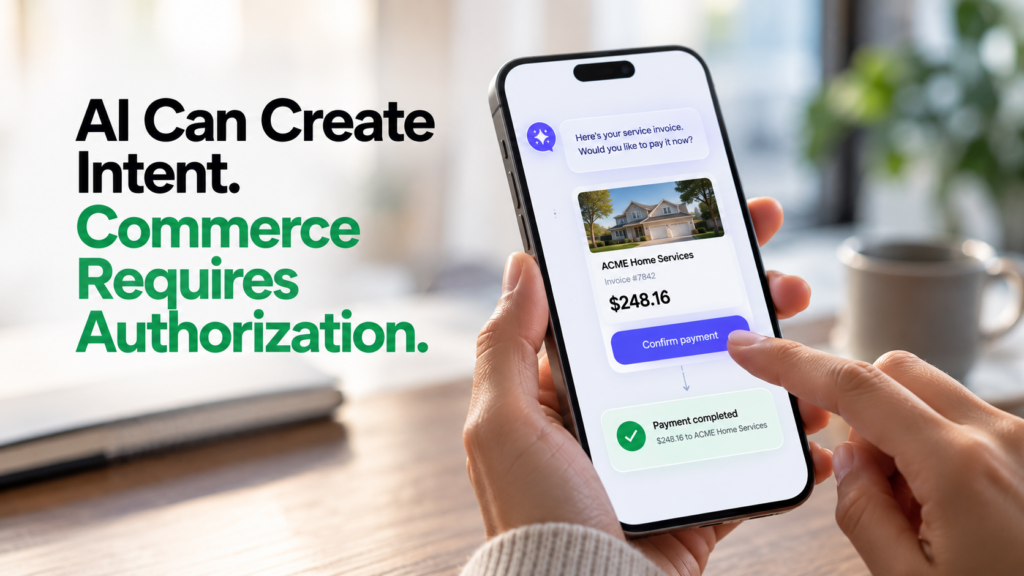
Agentic commerce takes this shift one step further.
AI systems are moving beyond answering questions and making recommendations toward taking actions on behalf of consumers. Visa’s work on agentic commerce is already focused on enabling AI agents to participate in payment flows while maintaining security, permission and control.⁵
This points to a critical distinction: understanding what someone wants is not the same as having authority to execute it.
Mastercard’s work on agentic commerce similarly focuses on identity, intent, controls, trusted execution and intelligence.⁶ Its Verifiable Intent work addresses how businesses can establish what a consumer actually authorized an AI agent to do.⁷
At Authvia, we’ve been building around this distinction for more than a decade. Our recently issued sixth U.S. patent, No. 12,711,476, “Conversational Payment Transactions,” covers technology for managing transactions through conversational interactions, including interpreting a specific authorization within the conversation, connecting that authorization to the correct transaction and initiating payment.⁸
The technology was built around a principle that becomes increasingly important as AI takes a more active role in commerce: before intent becomes a financial transaction, it must be connected to verified identity, valid authority and appropriate controls.
Whether an interaction begins with a human or an AI agent, businesses still need to answer fundamental questions: Who is acting? What are they trying to accomplish? What have they authorized? What are they permitted to do? And how should the resulting transaction be executed?
AI can create intent. Commerce still requires authorization.
Winning the Payment Moment Requires Orchestration
The next generation of payment experiences won’t be defined by adding another button, payment method or communication channel.
They’ll be defined by how effectively businesses connect engagement, identity, consent, authorization and transaction execution across the customer journey.
That requires businesses to rethink a few familiar assumptions. Optimize for action, not just engagement. Treat unnecessary transitions as potential lost conversion. Make trust visible. And orchestrate the experience across channels instead of optimizing each channel independently.
Businesses cannot control every factor that determines when a customer pays. But they can control how easy, trusted and immediate the experience is when that customer is ready to act.
The organizations that reduce the distance between intent and execution will be better positioned to capture that moment.
Because increasingly, commerce doesn’t begin at checkout.
It begins with the interaction.
Ready to Close the Gap Between Interaction and Transaction?
Authvia helps businesses connect customer engagement, authorization and payment execution across messaging, voice, web, mobile and AI-powered experiences.
See how Authvia powers Digital Omnichannel Commerce.
→ Explore the Authvia platform
Sources
1. Federal Reserve Board — Report on the Economic Well-Being of U.S. Households in 2025
2. PYMNTS Intelligence — The Service Commerce Performance Gap
3. Fiserv — Expectations & Experiences: Digital Billing and Payments
4. Visa — New Visa Research Finds Consumer Trust is Accelerating the Path to Agentic Commerce
5. Visa — Visa Announces Global Expansion of Agentic Ready Program
6. Mastercard — Trust in Agentic Commerce
7. Mastercard — When AI Starts Buying for You, Trust Becomes the Product
8. Authvia — Authvia Secures Sixth U.S. Patent, Keeping Human Authorization at the Center of Agentic Commerce