

How messaging, AI, and payment orchestration are moving commerce closer to the moment customers are ready to act.

For decades, commerce has been built around destinations: a checkout page, a billing portal, a point-of-sale terminal, or a call center. Whatever the destination, the expectation was largely the same. When it was time to pay, the customer had to go somewhere else to complete the transaction.
That model is changing.
Customers increasingly engage with businesses through text messages, email, mobile apps, QR codes, chat, voice, and now AI-powered experiences. As those interactions become more intelligent and actionable, there’s less reason for payment to exist as a separate step.
At Authvia, we believe this represents a fundamental shift in how commerce will work: customer engagement is becoming the new point of commerce.
Commerce Is Moving Closer to Customer Intent
Consider how many payment experiences still work today. A customer receives a message that a bill is due, clicks a link, authenticates, navigates a portal, finds the invoice, chooses a payment method, and finally pays. Every additional step creates distance between the customer’s intent and the business outcome.
But what if the original interaction could simply continue? A homeowner receives a message that a service is complete and pays immediately. A patient receives a balance notification and chooses a payment method. A customer scans a QR code on an invoice and continues the payment experience on their phone. An AI assistant identifies an outstanding balance and, with the customer’s permission, initiates the next step.
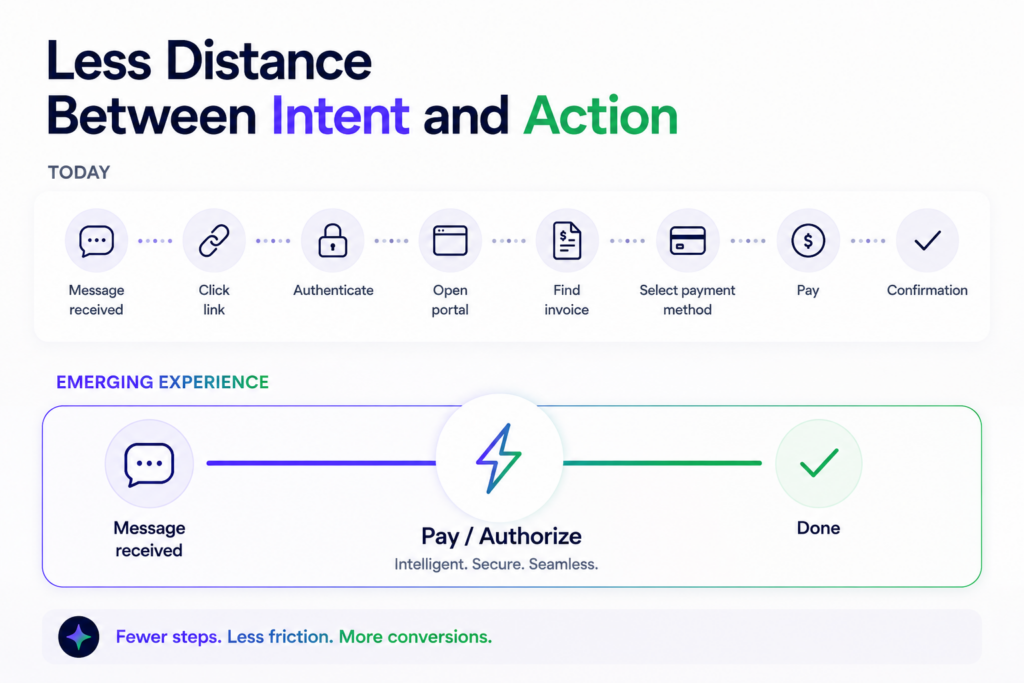
These may look like different use cases across different channels. We see them as the same shift: commerce is moving closer to the moment of customer intent.
“For too long, payments have been treated as a destination customers have to reach. We believe the future is about bringing commerce to the moment the customer is ready to act. The complexity of channels, payment methods, identity, consent, and processing should happen behind the scenes. For the customer, it should simply feel easy.”
— Chris Brunner Founder & CEO, Authvia
The Data Points to a Bigger Shift
Messaging offers one of the clearest examples of this evolution. Infobip’s 2026 Messaging Trends Report, based on 628 billion mobile interactions in 2025, found that global RCS traffic grew 311%. The same research found that nearly 98% of traffic on its platform now comes from customers using multiple communication channels, reinforcing how quickly businesses are moving beyond single-channel engagement.1
RCS itself is also reaching meaningful scale. Google reported in May 2026 that 2.5 billion RCS messages are being sent each day. At the same time, Google and Apple have begun rolling out end-to-end encryption for RCS between supported Android and iPhone devices, adding another layer of security to an increasingly mainstream communication channel.2
But messaging is only one part of a much larger change in digital behavior. AI is beginning to reshape how consumers discover, decide, and ultimately transact. Mastercard’s recent research found that 85% of consumers are open to working with an AI agent to find the best option and 74% are open to having one perform specific commerce tasks at their request. Yet only 10% are ready to let an agent make a purchase autonomously.3
That gap is telling.
Consumers are becoming comfortable with technology helping them move closer to a transaction. But when money actually moves, trust, permission, identity, and control still matter.
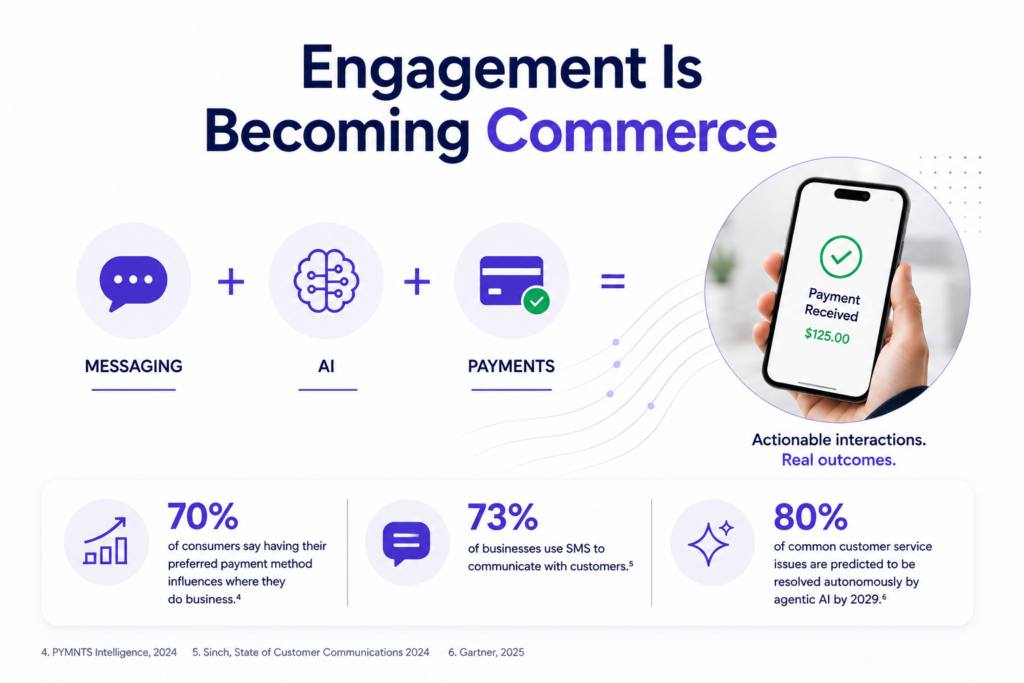
Taken together, these trends point toward something bigger than the evolution of messaging, AI, or payments individually. The line between engagement and commerce is starting to disappear.
Customers increasingly expect to move from receiving information to taking action without navigating an entirely separate journey. They want to ask a question, verify information, provide consent, select an option, make a payment, and receive confirmation.
Messaging is one place where that convergence is happening, but the same shift is occurring across email, voice, chat, apps, websites, QR codes, and AI-powered experiences. The channel matters less than what the customer can accomplish within the interaction.
The Payment Experience Has to Move Upstream
Historically, much of the payments industry’s innovation has focused on what happens once a customer reaches checkout: more payment methods, better authorization rates, faster processing, and improved fraud detection. Those things remain important.
But increasingly, the opportunity starts before checkout.
Businesses need to determine who the customer is, what they’re trying to accomplish, what they’ve authorized, which payment methods should be available, whether a fee should apply, whether a payment method is already on file, how a transaction should be routed, and what should happen after payment.
Solving those questions across one channel is relatively straightforward. Solving them consistently across every place a customer might engage is much harder.
That’s where orchestration becomes increasingly important.
Orchestration Is the Engine, Not the Experience
“Payment orchestration” has become a common term across the payments industry. Most businesses probably don’t think about it that way, and they shouldn’t have to.
They’re trying to solve much more recognizable problems: make it easier for customers to pay, reduce the work required to collect payment, offer the payment methods customers expect, maintain security and compliance, and add new channels without rebuilding the payment experience every time.
Orchestration makes those outcomes possible behind the scenes. It connects channels, payment methods, processors, identity, consent, business rules, and transaction data so neither the business nor its customers have to manage that complexity themselves.
The result should feel remarkably simple: the right experience, at the right moment, wherever the customer chooses to engage.

Trust Has to Travel With the Interaction
Removing steps doesn’t mean removing controls. In fact, as commerce moves into more digital interactions, establishing trust becomes even more important.
Who initiated the interaction? Who is on the other side? What did the customer agree to? What has been authorized? And as AI becomes more capable of acting on a customer’s behalf, what exactly has an agent been given permission to do?
The goal shouldn’t be to add friction everywhere in the name of security. Identity, consent, authorization, and payment security should become part of the infrastructure supporting the interaction.
The easier commerce becomes, the more seamlessly trust needs to travel with it.
From Point of Sale to Point of Interaction
The point of sale isn’t going away tomorrow. Neither are payment pages, portals, or traditional checkout experiences. But they are no longer the only places where commerce can happen.
A payment can begin with a text, a QR scan, an email, a conversation with an AI assistant, a service-completion notification, or a voice interaction.
The businesses that recognize this shift won’t simply build better destinations for customers to visit. They’ll connect commerce to the places customers already are.
Because the future of payments isn’t just about improving checkout. It’s about reducing the distance between “I’m ready” and “it’s done.”
Wherever customers engage, connected commerce should follow.
Ready to bring commerce closer to the moment of intent?
See how Authvia connects messaging, payments, identity, consent, and orchestration across the channels your customers already use.
Explore the Authvia platform →
Sources
- Infobip, Messaging Trends Report 2026. Source
- Google, End-to-End Encrypted RCS Messaging Begins Rolling Out for Android and iPhone Users. Source
- Mastercard, Encoding Trust: The Race for Intent, Consent and Control in the Agentic World. Source
- PYMNTS Intelligence, How Preferred Payment Availability Can Reduce Cart Abandonment. Source
- Sinch, Customer Connections 2024. Source
- Gartner, Gartner Predicts Agentic AI Will Autonomously Resolve 80% of Common Customer Service Issues Without Human Intervention by 2029. Source